
13
March'26With LPG prices rising and occasional supply shortages, many households in India are exploring induction cooking as a convenient alternative. Induction cooktops are efficient, fast, and easy to use.
However, a common question people ask is:
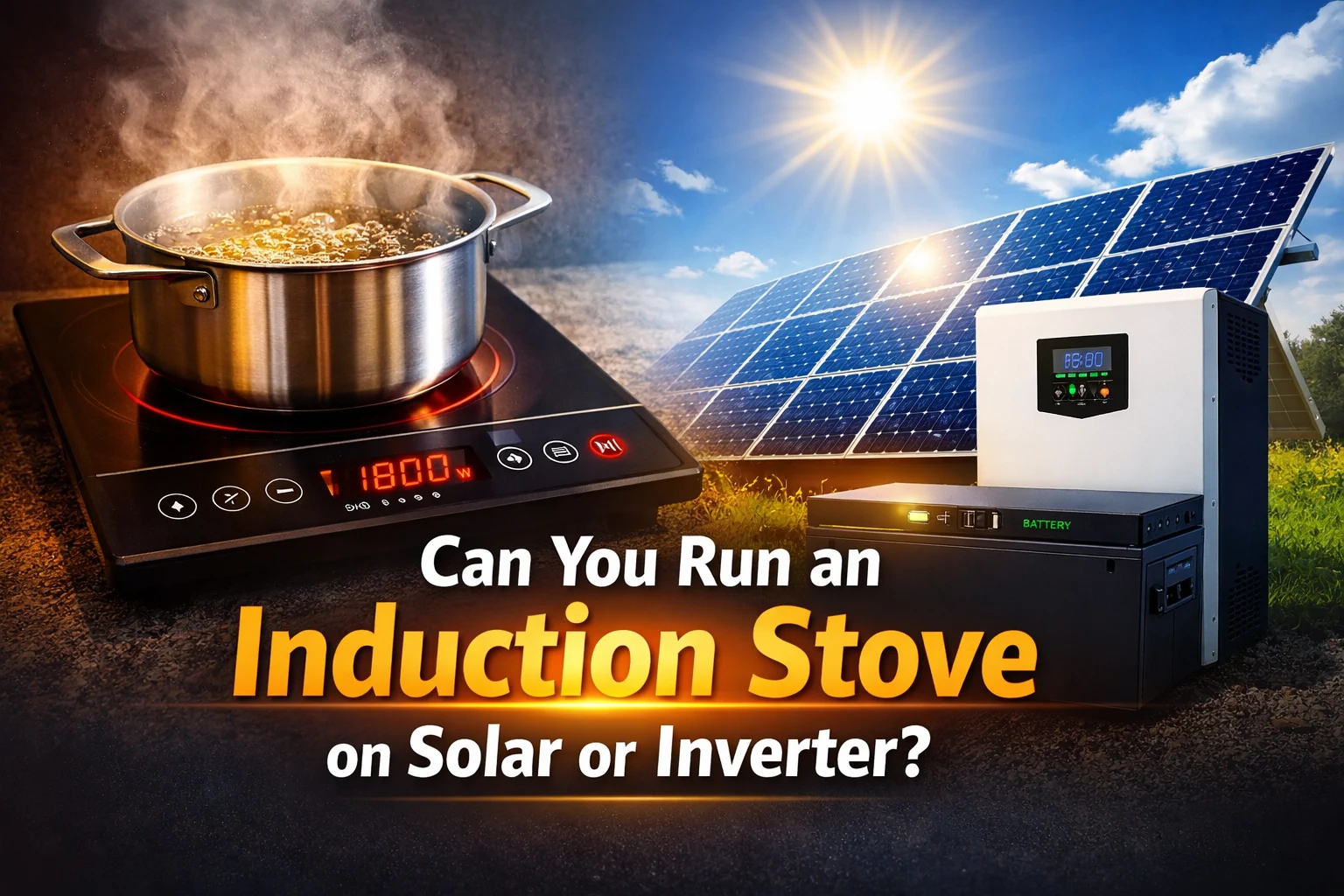
Can an induction stove run on an inverter or solar power system?
The short answer is yes — but only if the system is designed correctly. The inverter capacity, battery type, and wiring all play a crucial role.
In this article we explain:
Most induction cooktops used in Indian homes consume between 1200W and 2000W depending on the power setting.
Typical power levels:
| Cooking Mode | Power Consumption |
|---|---|
| Low heat / simmer | 300 – 600 W |
| Medium cooking | 800 – 1200 W |
| High heat | 1500 – 2000 W |
Although the rated power may be 2000W, induction cooktops usually cycle power on and off during cooking. This means the average power consumption is often lower than the peak rating.
However, the high peak load can still be challenging for small inverter systems.
Yes, but it depends on inverter capacity and battery capability.
A typical setup requirement looks like this:
| Appliance | Power |
|---|---|
| Induction cooktop | 1500 – 2000 W |
| Refrigerator | 150 – 300 W |
| Lights & fans | 200 – 400 W |
| Misc loads | 100 – 200 W |
Total possible load during cooking: ~2000W – 2800W
Because of this, a minimum of 3kW–5kW inverter is generally recommended if induction cooking will be used regularly. It is ideally best to go for size of 5kW or higher.
Small home UPS systems designed only for lights and fans often trip or shut down when an induction stove is switched on.
Across India, many homes using solar hybrid inverters already operate high-power appliances like:
Some Flin Energy customers regularly use induction stoves along with normal household loads on their inverter systems, especially when solar generation is available during the daytime.
When the system is properly sized, induction cooking can work smoothly with solar power.
Traditional home inverters in India often use lead acid tubular batteries. While these batteries work well for lights and fans, they face challenges with high-power appliances.
Main reasons:
1. Voltage Drop Under High Load
Lead acid batteries have higher internal resistance. When heavy loads like induction stoves start, voltage can drop significantly, causing the inverter to trip or shut down.
2. Limited Usable Capacity
Most lead acid batteries should only be discharged to 50% depth of discharge to maintain life.
This means a 200Ah battery effectively provides only about half its rated energy.
3. Poor High Current Capability
Induction cooking requires high burst currents. Lead acid batteries are not optimized for such loads.
4. Shorter Life Under Heavy Loads
Frequent heavy discharge cycles can reduce battery life significantly.
Lithium batteries (especially LiFePO4 chemistry) are much better suited for high-power appliances.
Advantages include:
Stable Voltage
Lithium batteries maintain stable voltage even during heavy loads, which prevents inverter shutdown.
High Discharge Capability
They can safely deliver much higher current compared to lead acid batteries.
Higher Usable Energy
Lithium batteries allow 90–95% usable capacity, meaning you get more energy from the same battery size.
Long Cycle Life
Typical lithium batteries provide 3000–6000 cycles, far higher than lead acid batteries. What this means is that while most tubular batteries last for maximum of 4-5 years, many lithium batteries can last for up to 16 years!
| Feature | Lead Acid Battery | Lithium Battery |
|---|---|---|
| Voltage stability | Poor under heavy load | Very stable |
| High current capability | Limited | Excellent |
| Usable capacity | ~50% | ~90–95% |
| Cycle life | 800–1200 cycles | 3000–6000 cycles |
| Suitable for induction loads | Often problematic | Much better |
A practical solar backup system might look like:
| Component | Recommended Size |
|---|---|
| Solar panels | 3kW – 5kW |
| Hybrid inverter | 5kW-6kW |
| Battery | 5–10 kWh lithium |
Such a system can comfortably run:
During the day, solar energy can directly power cooking loads, reducing grid electricity usage.
Not all inverter and lithium battery combinations are designed for high-power appliances.
Many entry-level lithium batteries used with inverters restrict discharge current to protect the cells, which can limit performance with appliances like induction cooktops.
Systems designed for higher discharge capability and stable performance handle such loads far more reliably.
Flin Energy systems are engineered keeping real Indian household usage patterns in mind — including loads such as:
Many installations across India already use Flin Energy hybrid inverters and lithium batteries to support such applications alongside solar generation to keep energy costs low.
Induction cooking can work very well with solar power and inverter systems, but the design of the system is critical.
Key takeaways:
As more homes adopt solar power, appliances like induction cooktops and EV chargers are becoming easier to support with modern hybrid inverter systems.
If you would like to install a solar system that can support induction cooking and other heavy appliances, our Flin Energy Star Engineers can help design the right solution for your location and usage.
You can contact our team or connect with a nearby installer from our network.
Comparing Ongrid, Offgrid, and Hybrid Solar Inverters: Which One Is Right for You?
Choosing the right solar inverter is key to getting the most out of your solar...
Why Lithium-Ion Batteries Are Better Than Lead-Acid for Solar Inverter Systems
As solar power adoption grows rapidly across homes and businesses, one of the most important...
Why You Should Choose Solar Energy in India
India is one of the best places in the world to adopt solar energy. With...
 Shop Flin

 Login
Login
 Register